
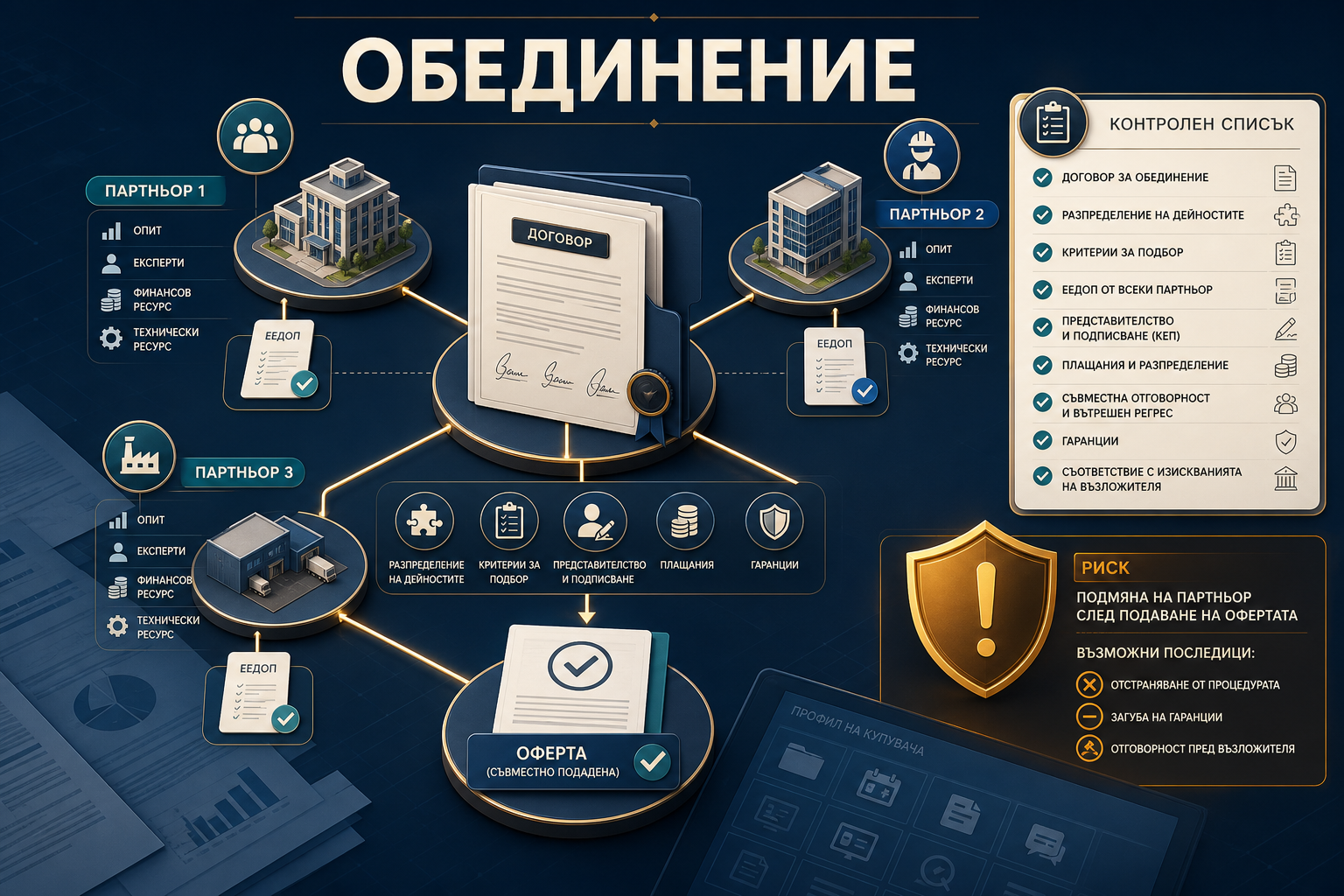
Participation in a Public Procurement Process Through a Consortium It allows several companies to combine their experience, expertise, financial performance, and technical resources. This can make it possible to bid on a contract that would be difficult for any single partner to fulfill on its own.
However, a joint bid also creates general legal risks. The formal signing of a brief contract between the partners is not sufficient. The allocation of activities, the demonstration of eligibility criteria, representation, and liability must be in accordance with the Public Procurement Act (PPA), the Regulations for the Implementation of the Public Procurement Act (RIPPA), and the documentation for the specific procedure.
When Is It Appropriate to Participate in a Public Procurement Process Through a Consortium?
A consortium is a practical solution when one company has the necessary experience, another has specialized experts, and a third has the equipment or financial capacity. The partners submit a joint bid, and if awarded the contract, they participate in its execution according to the agreed-upon division of responsibilities.
This model should be distinguished from the use of a subcontractor or the capacity of a third party. A member of the consortium is part of the participant itself. A subcontractor performs a specific portion of the contract without becoming a member of the bidder. A third party provides capacity to meet specific criteria in accordance with the law, but its role depends on the resources relied upon by the bidder.
Before forming a consortium, companies must assess not only their chances of winning the contract but also their ability to work together throughout the entire term of the contract.
What is the legal status of the association?
A consortium may participate even without separate legal personality. The contracting authority should not require the consortium to adopt a specific legal form in advance solely for the purpose of submitting a bid. If a specific form is necessary for performance, it must be consistent with the law and the terms of the contract.
When a contractor is selected, additional administrative steps may be required, including registration with the BULSTAT registry, opening a bank account, or arranging for tax and accounting services. It should not be automatically assumed that every consortium is required to complete all of these steps before submitting a bid. The contracting authority’s applicable rules and documentation are decisive.
What Should a Partnership Agreement Contain?
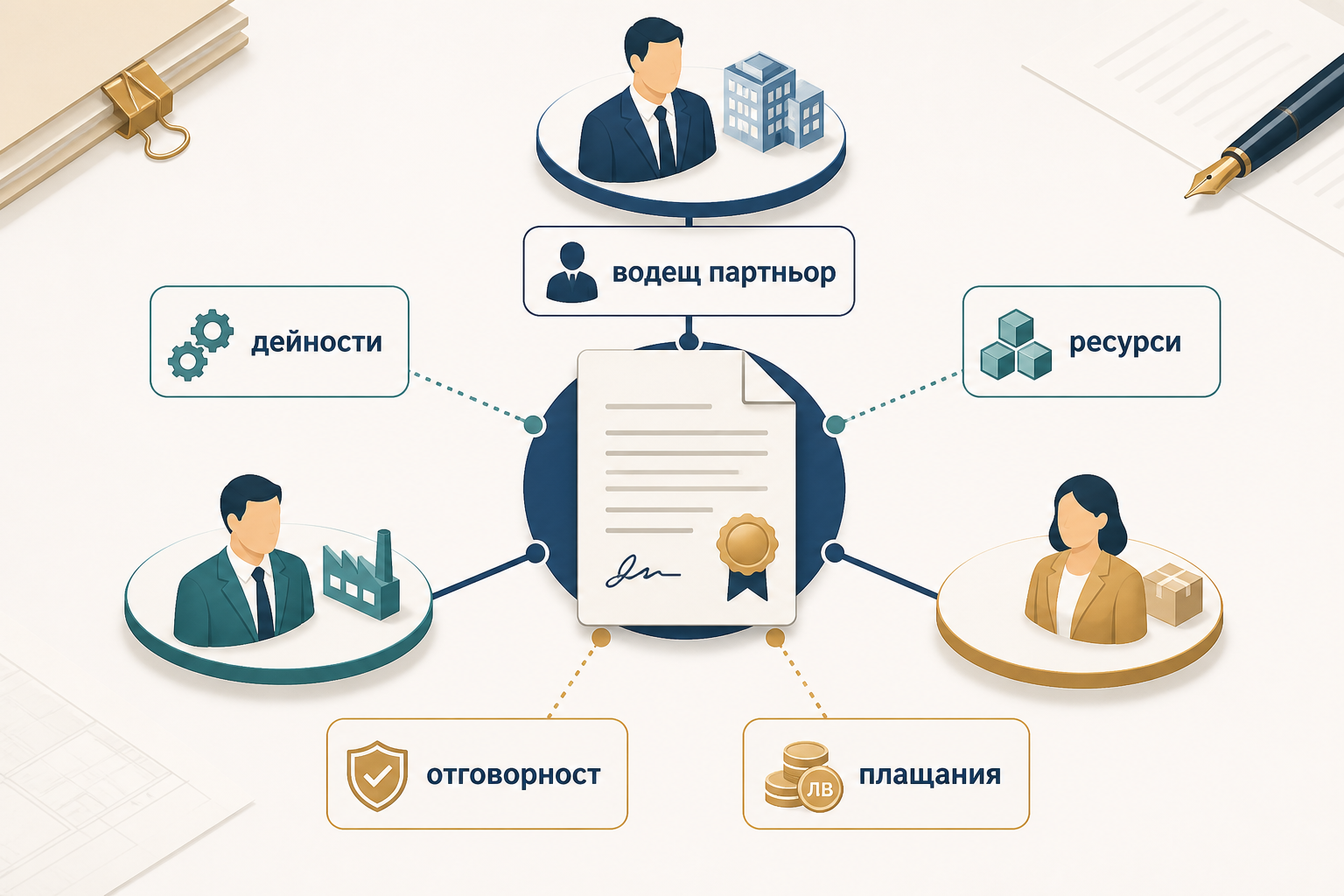
The contract between the partners must be drafted specifically for the particular public procurement contract; it should not be a general template unrelated to the subject matter. A well-structured contract should address at least the following:
- the name, purpose, and duration of the association;
- members and their identifying information;
- the lead partner and the representative to the contracting authority;
- the activities that each member will perform;
- the partners' percentage of participation, resources, and experts;
- the rules for decision-making and signing documents;
- the allocation of revenues, expenses, guarantees, and tax liabilities;
- liability for delay, breach, or nonperformance;
- the conditions for a member's resignation, replacement, or expulsion;
- the procedure for resolving internal disputes.
The contract must not contradict the technical proposal. If the contract specifies that one contractor will perform the construction work, but the bid assigns the same work to another contractor, the committee may question who will actually perform the contract and whether the requirements are met.
Distribution of Activities Among the Partners
Every significant activity must have a designated person responsible for it. This allocation is particularly important when a task requires a license, registration, professional qualification, or specific experience. In such cases, the task should be assigned to a member who possesses the necessary authority and capacity.
Specify who will provide the key experts, equipment, software, materials, and permits. Avoid phrasing such as “the activities will be allocated at a later date.” Such wording creates ambiguity precisely on the issues that the contracting authority evaluates.
How does the consortium demonstrate that it meets the selection criteria?
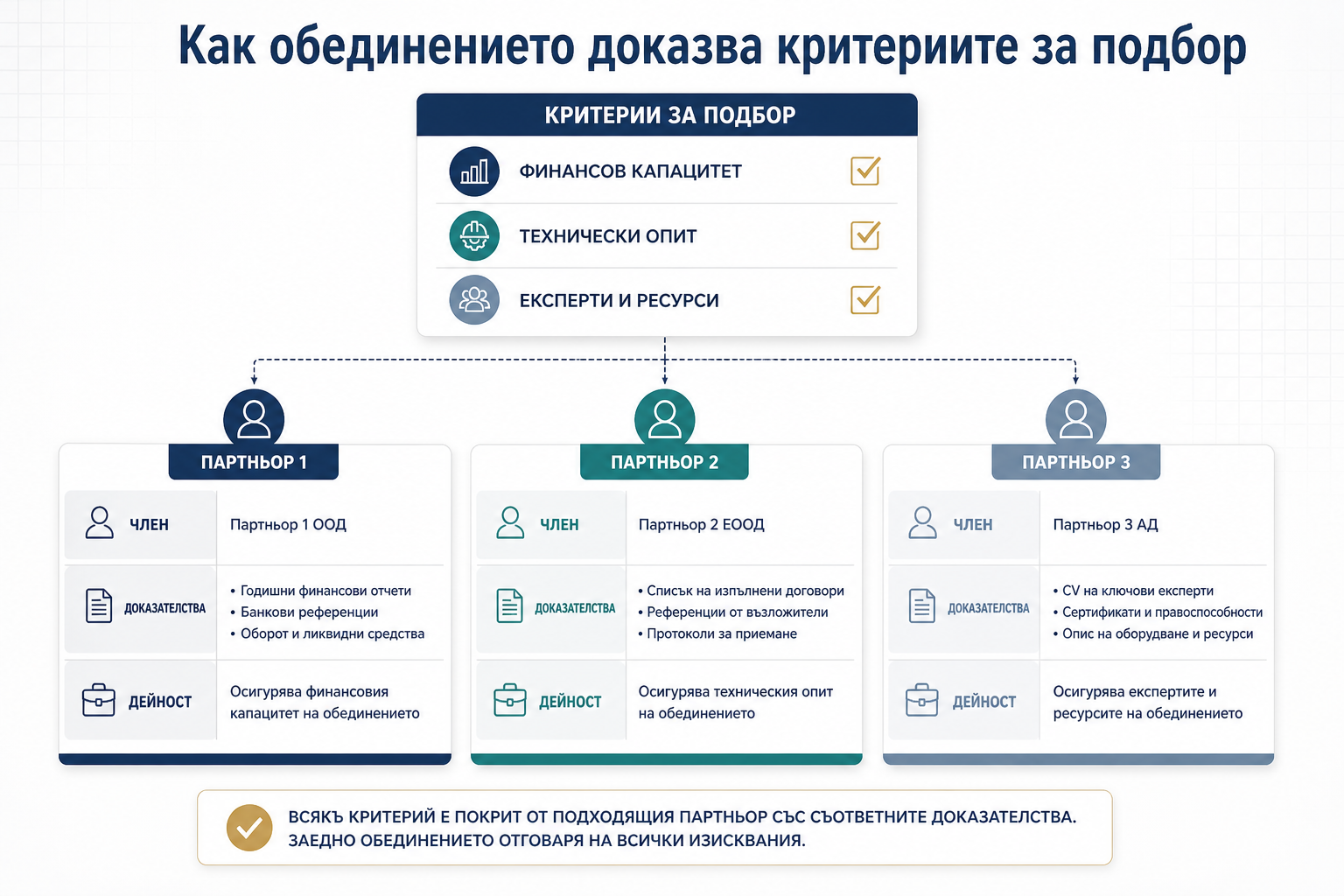
Depending on the nature of the criterion, members may collectively meet part of the requirements. However, this is not a universal rule. A criterion related to a specific professional activity, registration, or legal capacity may need to be met by the member who will actually perform that part of the contract.
With regard to financial and economic indicators, it must be verified how the contracting authority has formulated the requirement and whether it allows for cumulative coverage. For technical and professional capabilities, references, completed contracts, experts, and resources should be compared with the breakdown of activities.
It is a good practice to create a table that specifies the following for each criterion:
- the exact requirement;
- the part that covers it;
- the reported data;
- the evidence that may be presented;
- the activity for which the capacity will be used.
ESPD and Documents Accompanying the General Bid
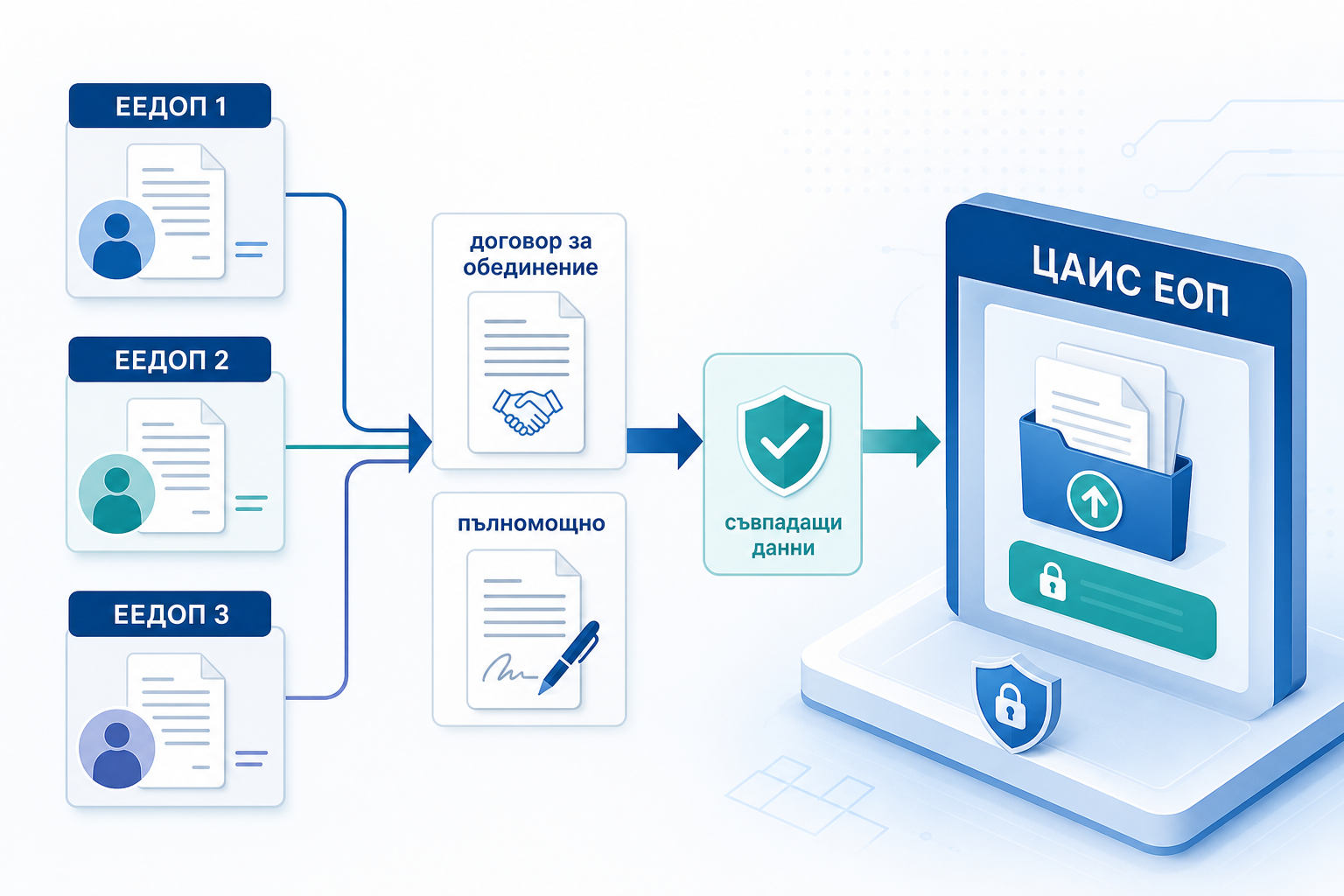
As a general rule, each member of the consortium submits a separate European Single Procurement Document (ESPD). This document is used to declare the relevant information regarding the member’s personal circumstances and the selection criteria.
Before submission, it is necessary to verify that the information in each ESPD corresponds to the consortium agreement and the joint bid. If a partner provides an expert or similar experience, this must be consistently reflected in all documents.
The package may also include the consortium agreement, the representative’s power of attorney, and any documents expressly requested by the contracting authority. Evidence supporting the declared circumstances must be submitted in accordance with the relevant stage and applicable rules. The documents required with the bid must not be confused with those requested upon request or prior to the conclusion of the contract.
Submission is done through The Centralized Automated Information System "Electronic Public Procurement" (CAIS EPP). For technical and regulatory questions, please refer to the official guidelines in the system and the information provided by The Public Procurement Agency (PPA).
Representation and Signing of the Proposal
The agreement must clearly specify who represents the consortium before the contracting authority. If a separate power of attorney is issued, it must cover the submission of the bid, the receipt of communications, the provision of clarifications, and other necessary actions.
Not every document must necessarily be signed by the same person. The ESPD of an individual member must be signed by its authorized representative when required. General documents are signed in accordance with the contract, powers of attorney, the rules of the Centralized Electronic Procurement System (CAIS EOP), and the contracting authority’s instructions.
Before submission, the validity and the holder of the qualified electronic signature are verified, as well as whether the final versions of the files have been uploaded to the correct locations.
Liability to the Client and Among Partners
The external liability of members is determined by the applicable rules, documentation, and the public procurement contract. It should not be automatically assumed that this liability is regulated in the same way in every procedure.
If joint and several liability is provided for, the principal may direct its claim against any partner in accordance with the applicable regime, regardless of which partner caused the specific breach. Therefore, the internal agreement must provide for recourse: the partner who has incurred a third-party expense or penalty must be able to seek reimbursement from the partner at fault.
Agree in advance on who will bear the penalties, the costs of rectifying defects, the increased costs resulting from delays, and the damages resulting from the loss of a license or a key expert. For suitable contracts, risk can be mitigated through insurance, collateral, or internal guarantees.
Payments and Financial Relationships
The contract must specify the bank account into which payments are to be made and how they are to be distributed among the members. The safest approach is to link the distribution to the activities actually performed, the acceptance documents, and the payment terms set by the client.
The partners must also arrange for the financing of the performance bond, general administrative expenses, insurance, and the necessary working capital. It is advisable to clarify the accounting and tax model before signing the offer, rather than after the first payment.
A Change in the Lineup: The Most Risky Moment

The departure or replacement of a member after the submission of the bid may alter the identity and capacity of the participant. If the withdrawn partner provided key expertise, registration, or an expert, the consortium may no longer meet the selection criteria.
A change made after the contract is signed may also create a risk of an impermissible amendment. Therefore, the internal agreement must restrict unilateral termination and provide for actions in the event of insolvency, loss of a license, material breach, or a dispute. The feasibility of a specific change is always assessed in light of the law, the documentation, and the stage of the proceedings.
Legal Checklist Before Submission
- The joint venture agreement was drafted specifically for this contract.
- The lead partner and the representative authority are clearly defined.
- The activities, resources, and responsibilities have been assigned without any conflicts.
- Each selection criterion is addressed by the appropriate section.
- Each member has submitted the required ESPD and declarations.
- The contract, the ESPD, and the technical proposal contain consistent information.
- Powers of attorney and electronic signatures are valid.
- Payments, guarantees, and general expenses have been settled.
- Provisions have been made for the consequences of noncompliance, a dispute, or resignation.
- The final documents were submitted correctly and on time through the CAIS EOP.
Frequently Asked Questions
Is it mandatory for the association to be a legal entity?
A consortium does not necessarily need to have separate legal personality in order to participate. However, the specific terms of the contract and any requirements for the conclusion and performance of the contract are reviewed.
Does each member have to submit a separate ESPD?
As a general rule, each member of the consortium submits a separate ESPD covering the circumstances relevant to it.
Can the members collectively meet the selection criteria?
Some criteria may be met collectively, but others must be met by the member who will perform the relevant activity. The decision depends on the nature of the criterion and the documentation.
Is BULSTAT registration required before submitting a bid?
It should not be assumed that this is always a prerequisite for filing. The necessity and timing of registration are determined based on the status of the association, the stage of the procedure, and the applicable requirements.
Can a member withdraw after submitting a bid?
Such a change carries a serious risk, especially if the member has been providing the necessary capacity. The feasibility must be analyzed on a case-by-case basis before any action is taken.
NAKOV | Attorneys at Law provides legal support for public procurement, including the preparation and review of joint venture agreements, verification of the ESPD, and coordination of the joint bid. Timely review minimizes the risk that internal conflicts among the partners could become grounds for disqualification or a problem during contract performance.


