
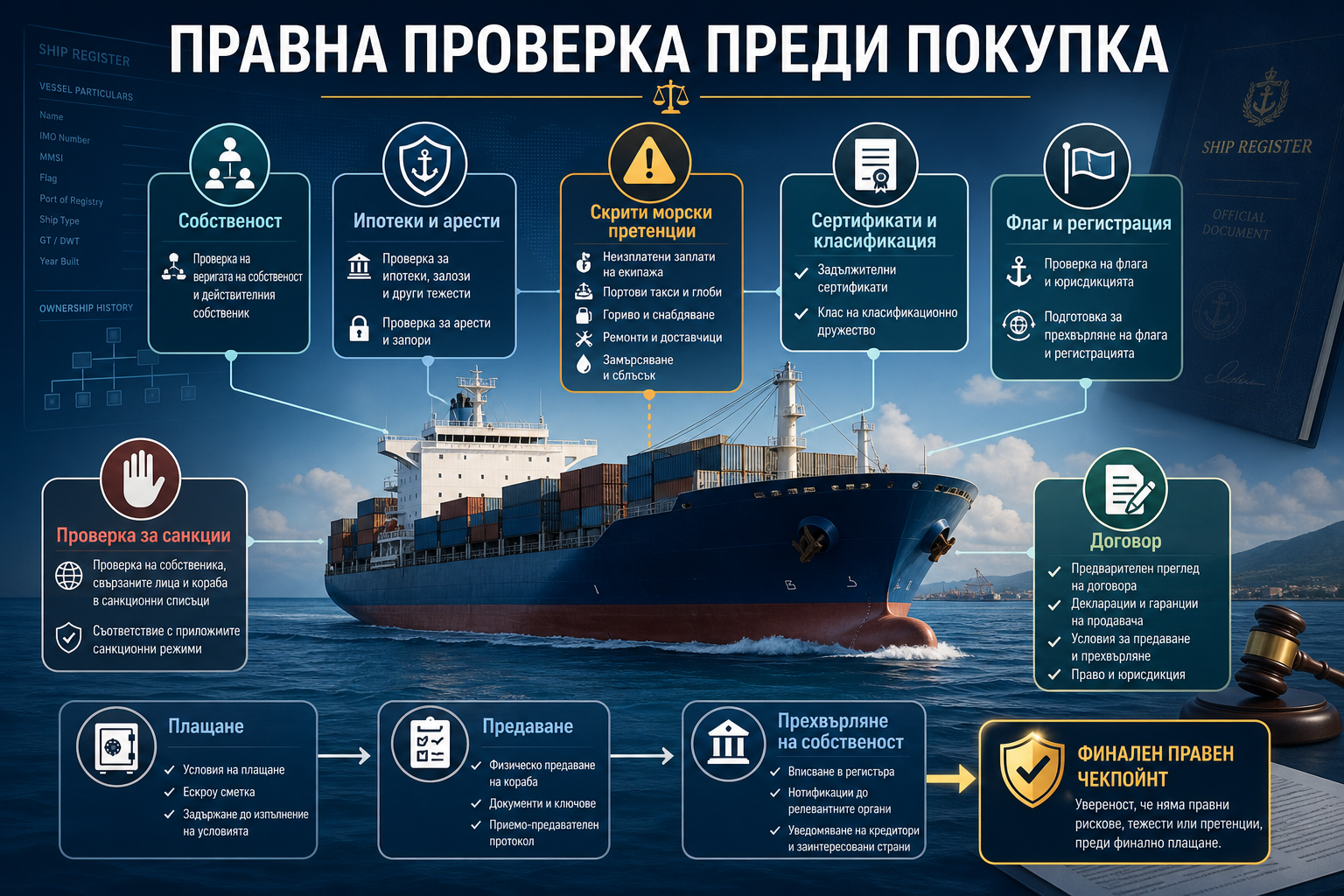
Buying a ship does not simply mean acquiring a valuable asset. Along with the ship, the buyer may face a registered mortgage, a lien, unpaid debts, a dispute over ownership, or an obstacle to re-registration. That is why a technical inspection is necessary but not sufficient. The legal framework requires experience in maritime law and port operations.
In sale and purchase of a ship Legal due diligence must be completed before final payment. Its exact scope depends on the flag state, the place of registration, the vessel's location, and the law applicable to the transaction.
Why a legal due diligence review is crucial before purchasing a ship
The technical inspection determines the condition of the hull, machinery, and equipment. The legal review addresses other issues: Is the seller the actual owner? Can the seller dispose of the vessel? Are there any encumbrances? And will it be possible to deregister the vessel and register it in the buyer’s name?
An incomplete due diligence review may result in a delayed transfer, an inability to use the property, or the need for the buyer to defend its rights against creditors and third parties. In an international transaction, the consequences often extend across more than one jurisdiction.
Verification of ownership and the seller's right to enter into the transaction
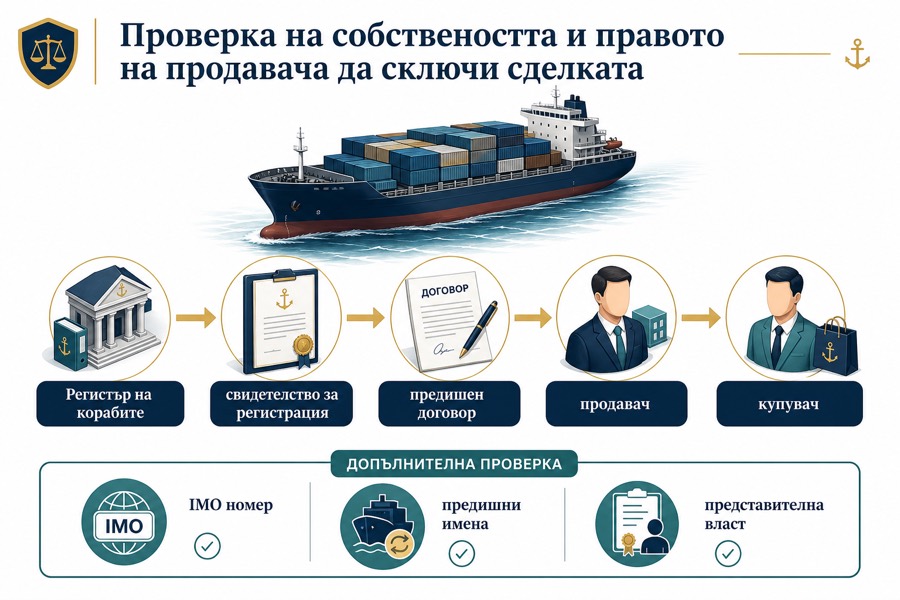
The first task is to establish an unbroken and convincing chain of title. The buyer must obtain a current extract from the relevant Ship Registry, the certificate of registration, and the documents on the basis of which the seller acquired ownership.
The name of the registered owner must match that of the seller under the contract. The vessel's identification details, its previous names, and its number assigned under the system of International Maritime Organization (IMO). Any discrepancy between the registry, the ship's documents, and the draft contract is a red flag that warrants further investigation.
When the seller is a company, the signatory’s authority to sign on behalf of the company must be verified. Depending on the applicable corporate law, a resolution by the governing body, approval by the shareholders, or consent from a financing institution may be required.
Check for mortgages, liens, and hidden maritime claims
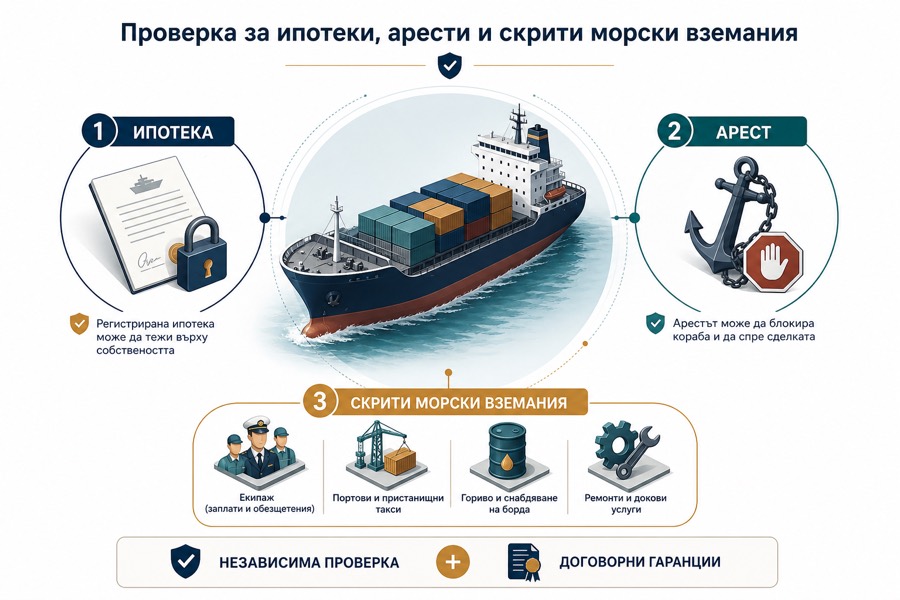
The extract from the ship registry must show any registered mortgages and other encumbrances subject to registration. If there is a mortgage, the contract should specify whether it will be discharged prior to the transfer, concurrently with payment, or through another safeguard. One should not rely solely on the seller’s promise.
A check is also made to determine whether the ship has been arrested or is subject to a disposition prohibition. Both the registry and information from courts, port authorities, and local representatives in the country where the ship is located may be relevant.
A registry search does not prove the absence of all claims. Some maritime liens and claims may not be publicly recorded. Therefore, it is necessary to investigate potential liabilities for:
- salaries and other payments to the crew;
- port and canal fees;
- fuel and supplies delivered;
- repair and rescue services;
- damage caused by a collision, pollution, or other maritime incident.
Representations by the seller, confirmations from key creditors, and contractual guarantees are useful, but they should supplement, not replace, an independent review.
Registration, Flag, and Regulatory Status
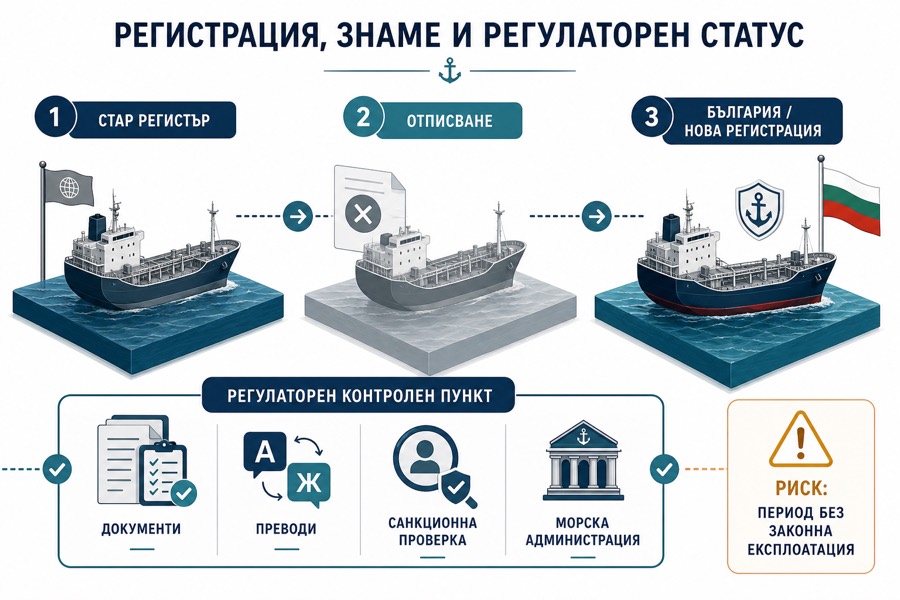
The buyer must verify that the registration is valid and that the vessel is legally flying the flag indicated in the documents. The regulations of the relevant flag state govern the procedures for transfer, deregistration, and issuance of a certificate of deregistration.
If the vessel is to be registered in Bulgaria, the requirements of Executive Agency "Maritime Administration". It is necessary to coordinate the documents, translations, the form of the contract, and the date on which the old registration will be terminated. This avoids a period during which the vessel cannot be legally operated.
The flag history and names, detentions during port inspections, and any sanctions-related restrictions are also verified. The parties, beneficial owners, financiers, the vessel, and related companies should be cross-checked against applicable sanctions regimes, including the official Map of European Union Sanctions.
Documents and certificates that must be reviewed
In addition to the title documents, the buyer must receive a current set of ship documents. The specific list depends on the type, size, purpose, and area of operation of the vessel, but typically includes registration, classification, safety, and environmental certificates.
A check is performed to determine whether the selected classification society recognizes the vessel, whether there are any outstanding recommendations, and whether any mandatory surveys are pending. Insurance coverage, the accident history, and reported claims should also be reviewed.
It is important to identify all existing contracts that may affect the transfer or future operation: charter agreements, management agreements, lease agreements, repair agreements, crew agreements, port services agreements, and financing agreements. The sales agreement must clearly specify which relationships are terminated and which, if any, are assumed by the buyer.
How the Contract Protects the Buyer
The contract must precisely identify the vessel by name, IMO number, flag, registration number, and main characteristics. It should be clear whether the price includes equipment, spare parts, fuel, documentation, and other supplies.
Protection for the buyer typically includes representations and warranties by the seller that the seller is the owner, has the right to dispose of the vessel, the vessel is free of undisclosed encumbrances, and there are no hidden contracts or claims. In the event of a breach, the contract must provide for the right to rescind, compensation, or another effective remedy.
Before payment, conditions may be imposed, such as:
- submission of a current certificate of ownership and encumbrances;
- cancellation of mortgages and lifting of liens;
- obtaining corporate and regulatory approvals;
- a satisfactory result from the technical and legal review;
- readiness for deregistration and subsequent registration.
The contract must specify the governing law and the method of dispute resolution. The choice between court proceedings and arbitration is made based on the parties’ jurisdictions, the location of the assets, and the enforceability of the future decision.
Payment, Delivery, and Transfer of Ownership
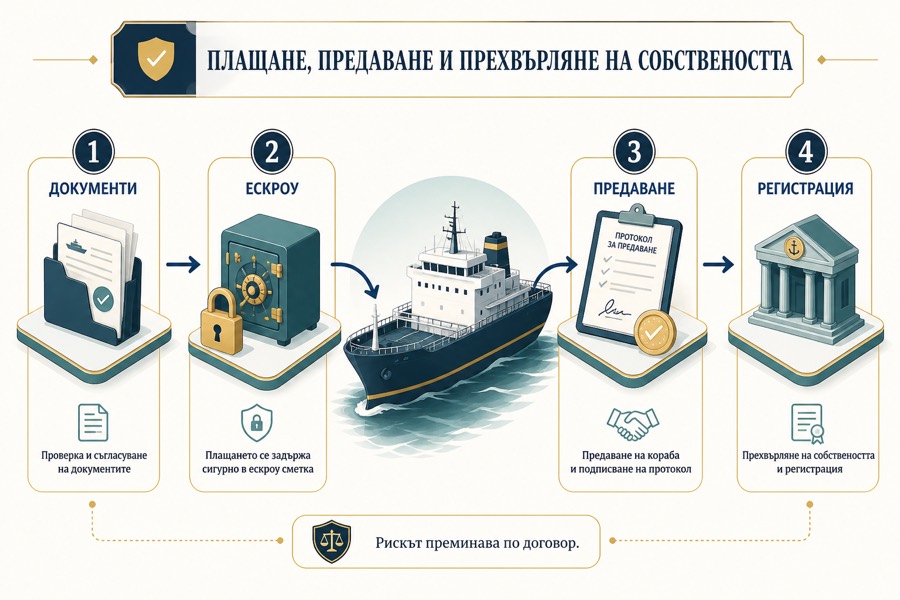
Payment must be contingent upon the submission of the agreed-upon set of documents. For appropriate transactions, an escrow arrangement may be used so that the payment is released only upon fulfillment of the predetermined conditions.
Upon completion of the transaction, the following documents are typically exchanged: the deed of transfer, handover protocols, certificates of absence or cancellation of encumbrances, corporate resolutions, and documents for deregistration. The handover protocol must specify the date, time, and place of the handover, the condition of the vessel, and the moment at which the risk passes to the buyer.
Upon completion of the transaction, the vessel is deregistered from the old registry, re-registered, and the necessary notifications are sent to the competent authorities, the insurer, and the classification society.
Checklist Before Signing and Paying
- Verify the seller's identity and authority to act on behalf of the seller.
- Check the ownership documents and the information in the Ship Registry.
- Check for mortgages, liens, encumbrances, and pending disputes.
- Review any outstanding payments owed to the crew, ports, and suppliers.
- Check the flag, IMO number, certificates, and class.
- Conduct a sanctions screening of the vessel and related parties.
- Please specify the conditions for cancellation and re-registration.
- Make payment contingent upon the submission of all required documents.
The transaction must be halted or restructured if ownership cannot be proven, the vessel’s details are inconsistent, the seller refuses to provide documents, there are unexplained encumbrances, or there is no realistic path to deregistration and re-registration.
Frequently Asked Questions
Can a ship with a registered mortgage be sold?
It is possible, but the mortgage does not automatically disappear as a result of the sale. The buyer must request a procedure for repayment and cancellation in accordance with applicable law and the registry.
How can you check whether a ship has been detained?
The verification process depends on the ship's location and the competent jurisdiction. It may be necessary to obtain information from a court, port authorities, registries, and a local attorney.
Are the previous owner's obligations transferred?
Not every obligation is assumed personally by the buyer, but certain maritime claims and encumbrances may affect the vessel itself. Therefore, each risk must be analyzed separately.
When does ownership transfer to the buyer?
The timing depends on the contract and the applicable law. It must be clearly coordinated with the payment, the signing of the documents, the transfer, and the registration procedures.
Is a maritime law attorney necessary?
Specialized assistance is particularly important in international transactions, financing, encumbrances, flag changes, or suspected claims. An attorney can coordinate due diligence and link the results to the protective clauses in the contract.
Legal protection before the transaction, not after a dispute arises
The buyer’s strongest position is before payment and acceptance of the vessel. NAKOV | Attorneys at Law can conduct a legal review of the title, encumbrances, and documents, as well as draft or review the contract and the mechanism for closing the transaction.


